
Bridgett Renee Health Journal · Research review with commentary by Maurice Massey, Founder and Holistic Wellness Coach. Not medically reviewed.
Animal research reveals how fructose can help certain tumors grow—even when the cancer cells cannot readily use that sugar themselves.
What if a tumor doesn’t need to consume a sugar directly to benefit from it?
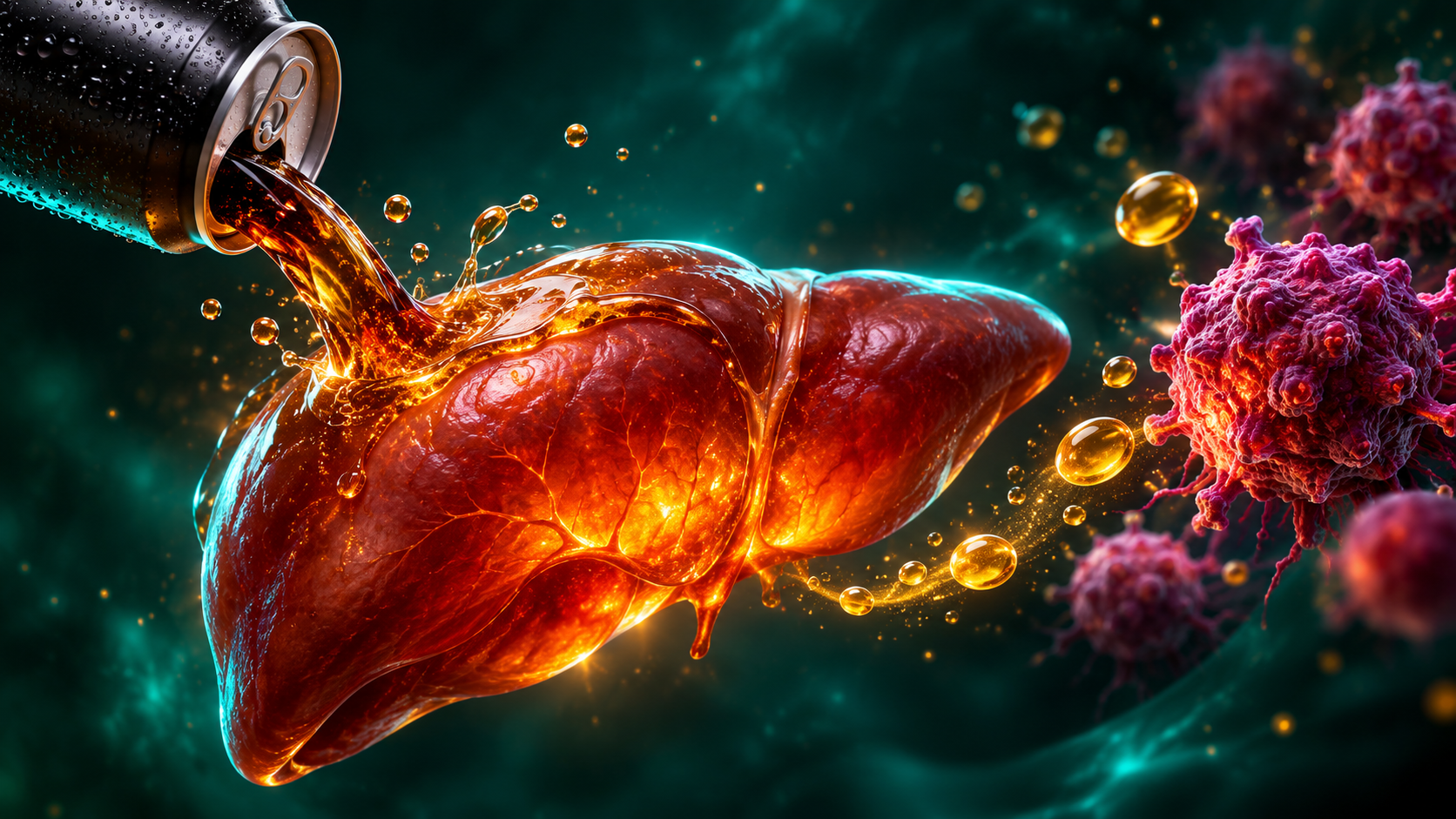
A study published in Nature on December 4, 2024, uncovered a surprising relationship between fructose, the liver, and cancer growth. Researchers at Washington University in St. Louis found that fructose supplementation accelerated tumor growth in animal models of melanoma, breast cancer, and cervical cancer.
The twist: the cancer cells tested could not readily process fructose. Another organ helped bridge the gap. [1]
The liver became a middleman.
Liver cells processed fructose and released fats, including a group called lysophosphatidylcholines, or LPCs. Cancer cells absorbed those fats and used them to build the membranes needed to make more cells.
Think of a growing tumor as a construction site. It needs building materials as well as energy. In these experiments, the liver helped supply some of those materials. Blocking an enzyme involved in fructose metabolism prevented the extra tumor growth associated with fructose in mice. That makes this pathway an intriguing research target, rather than an established cancer treatment. [1]
The detail that deserves a second look
The researchers reported faster tumor growth without changes in body weight, fasting glucose, or fasting insulin. Within these experiments, the effect did not depend on the animals first becoming heavier or developing those metabolic changes. [2]
That challenges an easy assumption: that a dietary exposure can matter only after it shows up on the scale. Whether the same pattern applies to people with cancer remains an unanswered question.
Fructose-containing sweeteners also appear beyond the dessert aisle. WashU’s report points to products such as sauces, dressings, and ketchup—one reason this research reaches into everyday conversations about the food supply. [2]
Before this becomes another “sugar feeds cancer” headline
This was laboratory and animal research, not a clinical trial proving that eliminating fructose shrinks tumors or improves survival in people. It does not establish that a particular food caused someone’s cancer.
The National Cancer Institute’s discussion specifically cautions against trying to eliminate all fructose. Whole fruit should not be treated as equivalent to high-fructose corn syrup in ultra-processed products. Nor does this study establish that removing carbohydrates can starve cancer. [3]
For someone undergoing treatment, major dietary restrictions should be discussed with their oncology team and an oncology dietitian, especially when maintaining weight and nourishment is already difficult.
The question this research leaves us with is compelling: How much of a tumor’s food supply depends on what the rest of the body does first?
Understanding that relationship could change where researchers look for future treatments.
Maurice’s perspective: Stop dismissing research as “just mice”
I take issue with using “it was only studied in mice” to brush aside meaningful findings. Mice and rats are mammals. They share many of our organs and biological systems, which is precisely why scientists use them to investigate disease and potential treatments. Animal research has helped lay the groundwork for many medicines. In my view, findings like these deserve serious attention and follow-up—not an automatic dismissal. “Not yet proven in humans” should describe the next research question, not end the conversation.
Maurice Massey
Evidence context: Shared mammalian biology makes animal studies valuable, but differences in metabolism, immune responses, and disease can change the outcome in people. FDA approval generally depends on human safety and effectiveness evidence; success in mice alone does not establish either. [4, 5]
Sources and credit
1. Fowle-Grider, R. et al. Dietary fructose enhances tumour growth indirectly via interorgan lipid transfer. Nature 636, 737–744 (2024). DOI: 10.1038/s41586-024-08258-3.
2. Washington University in St. Louis, Talia Ogliore. Research reveals how fructose in diet enhances tumor growth. December 4, 2024.
3. National Cancer Institute, Nadia Jaber. Fructose Fuels Cancer Growth Indirectly, Lab Study Finds. January 14, 2025.
4. National Human Genome Research Institute. Mouse Model.
5. U.S. Food and Drug Administration. Drug Development and Review Definitions and Cross-Species Immune System Reference.

A note about the author.
Maurice Massey is the founder of Bridgett Renee Health, bringing 19 years of hands-on coaching experience. His work is dedicated to the memory of his wife, Bridgett Renee.
Meet Maurice ↗