
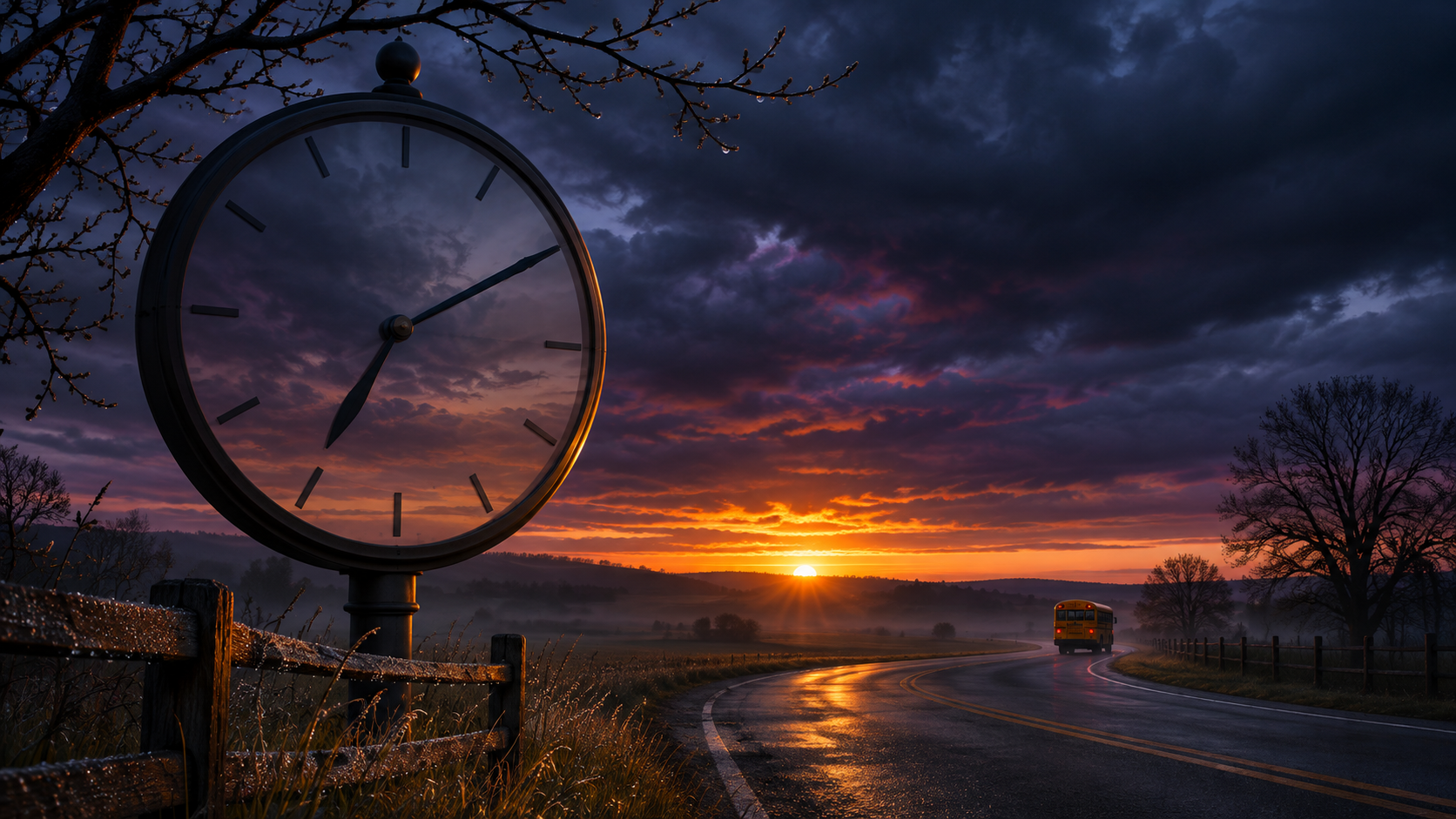
Brighter evenings come with a tradeoff: darker mornings. A University of Washington study raises a practical question about permanent daylight saving time: what happens to children heading to school before the sun comes up?
What the researchers found
Led by Guadalupe Rodríguez Ferrante and Horacio de la Iglesia, the team used school schedules and sunrise times in 14 states to estimate morning travel under different clock policies. Compared with today’s seasonal system, permanent daylight saving time would add about 356 million school trips before sunrise across those states. A broader nationwide calculation projected more than 2 billion additional dark-morning trips each year.
These are modeled travel estimates, not observed outcomes after a nationwide policy change. The nationwide calculation uses assumptions about departure times; individual communities would experience different effects.
Darkness and the school commute
The researchers also examined a decade of fatal-crash records. Among those crashes, the odds of pedestrian involvement were higher before sunrise, including for children aged 5–18. This association does not mean that every child’s risk doubles, or establish exactly how many additional crashes a clock change would cause.
Why morning light matters to our body clock
Morning light helps synchronize our circadian rhythm—the internal timing system involved in sleep, mood and appetite. Keeping clocks an hour ahead through winter would make sunrise later by the clock, potentially reducing morning daylight before school. Early-starting schools and communities toward the western edge of a time zone face particular concerns.
Ending twice-yearly clock changes and choosing permanent daylight saving time are separate decisions. Permanent standard time is another option. This study focused on school travel and light exposure; it did not prove that permanent daylight saving time causes a particular disease.
A brief perspective from Maurice Massey
My view is simple: if it isn’t broken, don’t fix it. In my opinion, manipulating the clock may throw off our circadian rhythm and potentially contribute to health problems for some people. Before making changes, we should consider the body’s natural rhythm. Our schedules should respect sleep, morning light and our children’s safety—not just the appeal of a brighter evening.
— Maurice Massey, Founder and Holistic Wellness Coach, Bridgett Renee Health
For related reading on everyday habits and brain health, explore Walking, Brain Health, Memory and Hope.
Sources and credit
This original BRH research summary credits the University of Washington research team. Read the ScienceDaily report (November 4, 2026), based on University of Washington materials; Sarah McQuate’s UW News report (October 29, 2026); and the Current Biology study record, “Over a billion more dark-morning school commutes for K–12 children under the Sunshine Protection Act” (DOI: 10.1016/j.cub.2026.10.014).
Educational research reporting, not individualized medical advice.

A note about the author.
Maurice Massey is the founder of Bridgett Renee Health, bringing 19 years of hands-on coaching experience. His work is dedicated to the memory of his wife, Bridgett Renee.
Meet Maurice ↗